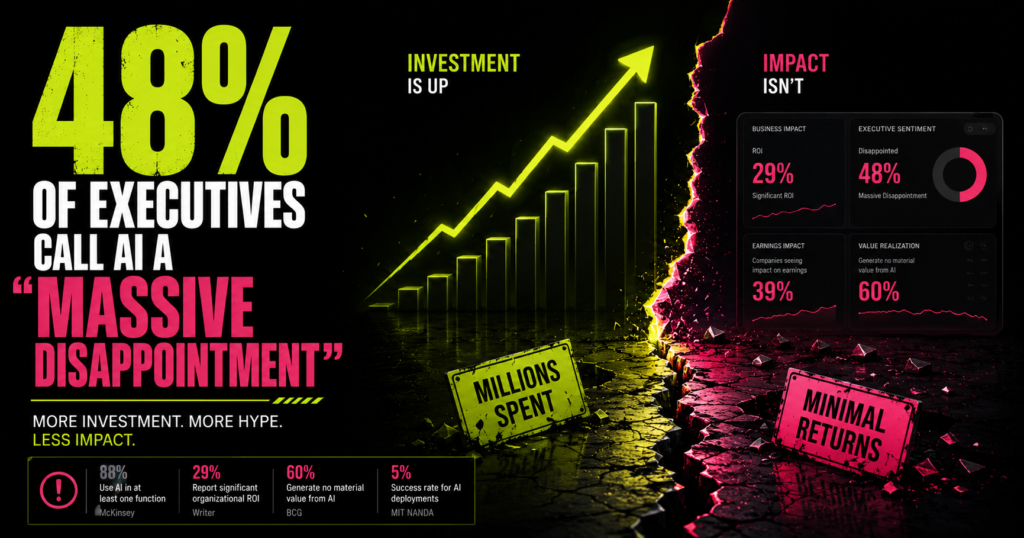
48% of executives now call their AI adoption efforts a “massive disappointment.” That’s up from 34% last year.
The more money organizations spend on AI, the more disappointed leadership becomes.
Only 29% report significant organizational ROI. 54% of C-suite executives say AI is “tearing their company apart.” McKinsey’s data: 88% of companies use AI in at least one function, but only 39% see any impact on earnings.
BCG’s AI Radar 2026: 60% of companies generate no material value from AI investments. MIT’s NANDA Initiative, based on 150 interviews and 300 public deployments, puts the success rate at 5%.
Five percent.
Here’s what I see on the ground working with operators and SMB leaders every week: the disappointment isn’t with the technology. It’s with what happens when extraordinary technology meets ordinary organizational readiness.
Most businesses approach AI like buying software, evaluate options, pick a tool, roll it out. That playbook fails with AI because AI doesn’t just sit in a workflow. It reshapes the workflow. If the workflow wasn’t well-understood before AI entered the picture, AI amplifies the dysfunction.
The 48% aren’t wrong. They’re experiencing the predictable consequence of deploying transformative technology into organizations that haven’t done the readiness work. No clear objectives. No success metrics defined before deployment. No governance. No training for the humans who have to work alongside the AI.
The 5% that succeed aren’t using better AI. They’re using the same AI with better organizational infrastructure around it.
The bottleneck to AI value isn’t the model. It’s the operator.
The tool was never the problem. The readiness was.
THIS CAME OFF THE BUILD FLOOR.
Every field note maps back to the 13-layer discipline taught free inside The Faction. 468+ builders. No credit card.