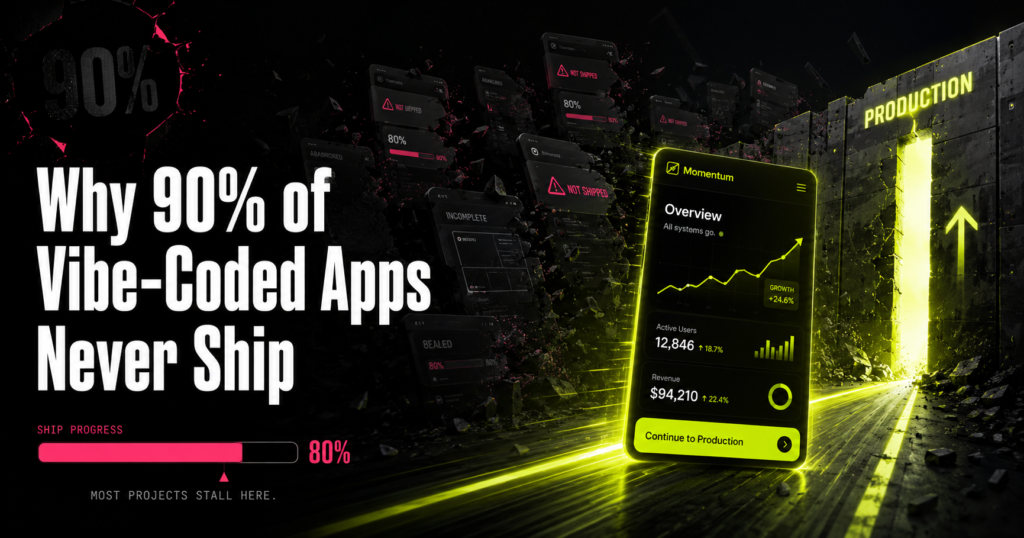
Ninety percent of vibe-coded apps will never see a single real user.
That’s not a talking point I pulled from a sales deck. That’s the emerging consensus across multiple 2026 research reports, from SD Times to Gartner to Veracode, all converging on the same conclusion: the vast majority of AI-built prototypes die somewhere between “it works on my laptop” and “it’s live in production.”
The vibe coding market just crossed $4.7 billion. Sixty-three percent of the people using these tools aren’t developers. The tools are genuinely remarkable you can describe what you want in plain English and watch a functional application materialize in minutes. I’ve done it. I’ve watched operators in our community do it. The first 80% is magic.
The last 20% is where everything falls apart.
Here’s what nobody in the vibe coding hype cycle wants to talk about: 45% of AI-generated code contains at least one OWASP Top 10 vulnerability when shipped without human review (Veracode 2025 GenAI Code Security Report). Infrastructure costs balloon up to 400% at production scale because of unoptimized schemas and inefficient queries. And 48% of developers, the people who should know better, don’t review AI-generated code before committing it.
Now imagine what’s happening when the person building is an operator, not a developer.
I run a group that builds production software for SMBs. I’ve seen what happens when a vibe-coded prototype meets a real customer, a real database, and real regulatory requirements. The app that “works” in a demo environment starts leaking API keys stored in frontend code. The SQLite database that was fine for testing has no migration path. There’s no CI/CD pipeline, no error tracking, no audit trail. It’s ugly.
The prototype isn’t the product. It never was. But the current narrative treats it like one.
The market has created a fascinating paradox: the tools to start building have never been more accessible, but the gap between starting and shipping has never been wider. Every week in our community, I watch operators hit what I call the “finishing wall” the moment when the thing they built needs to actually handle money, store customer data, survive a security audit, or simply work when more than five people use it at the same time.
The 90% failure rate isn’t a technology problem. The tools work. The models are good enough. The failure is operational, it’s the absence of the systems, knowledge, and infrastructure that turn a prototype into a product.
This is the part the market hasn’t figured out yet. Billions are flowing into tools that make the first 80% easier. Almost nothing is flowing into the finishing layer, the people, processes, and production readiness that make the last 20% possible.
If you’re building something that matters, something that touches customer data, processes payments, or runs a piece of your business, the question isn’t whether you can vibe code it. You can. The question is whether you can finish it.
And right now, the data says nine out of ten of you won’t.
The operators who ship aren’t the ones with the best prompts. They’re the ones who treat the prototype as the starting line, not the finish line.
THIS CAME OFF THE BUILD FLOOR.
Every field note maps back to the 13-layer discipline taught free inside The Faction. 468+ builders. No credit card.